Climate justice means that we deal with the consequences of climate change in a fair way—or at least as fairly as possible. This is important because climate change affects us all. Some groups are hit harder than others, for example in terms of health or livelihood security. This depends on how equity is incorporated into policy and implementation.
For example, heat stress is more common in low-income neighborhoods, while sustainability subsidies mainly go to people who know how to easily navigate the application process. In addition, mold problems—fueled in part by more extreme rainfall—affect neighborhoods with poorly maintained (public) rental housing much more frequently.
For governments, companies and organizations working on the climate transition, climate justice is often already high on the agenda. Nevertheless, discussions held with professionals and experts by experience as part of the 'ACT: Accelerating Just Climate Transitions in Urban Regions' program reveal that applying this in daily practice remains a challenge. The Climate Justice Handbook aims to bridge this gap between theory and practice.
How does the handbook help?
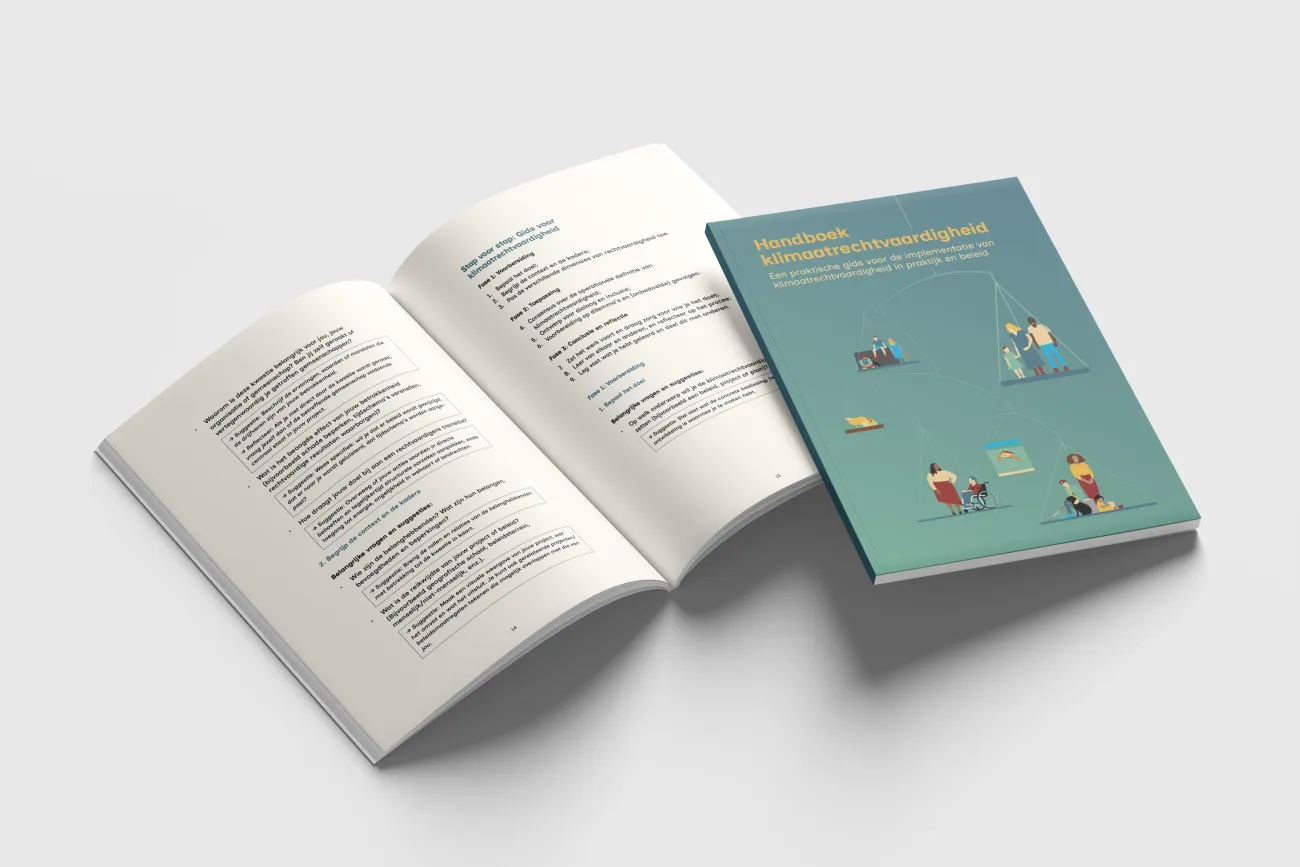
The Climate Justice Handbook is intended for policymakers, urban planners, researchers, urban designers, teachers, civil servants, healthcare professionals and entrepreneurs in the (Caribbean) Netherlands who are looking for practical guidance on applying climate justice in their work. Using recent case studies, the handbook demonstrates how an abstract concept such as 'climate justice' can be translated into practice.
The first part of the handbook provides concrete steps to better understand climate justice and integrate it into daily work. A workshop canvas helps in developing a workshop in which people from diverse backgrounds discuss the topic.
The second part of the handbook provides further explanation of the concept of climate justice and an overview of the literature on the subject.
About the authors and the ACT work program
This publication was produced as part of the 'ACT: Accelerating Just Climate Transitions in Urban Regions' program of the Dutch Climate Research Initiative (KIN). Within ACT, scientists and climate professionals from the field are developing the agenda for climate transition and local action plans for the urban environment, as this is where the challenges and opportunities for just transitions are most visible. The authors of the handbook are all directly involved in the ACT work program: Joyce Browne, Charisma Hehakaya, Julliëtte Mattijsen, Dat Nguyen, and Marthe Singelenberg, with feedback and contributions from many other stakeholders.