
Three years of KIN. Three leaders. One mission: to drive and embed the climate transition.
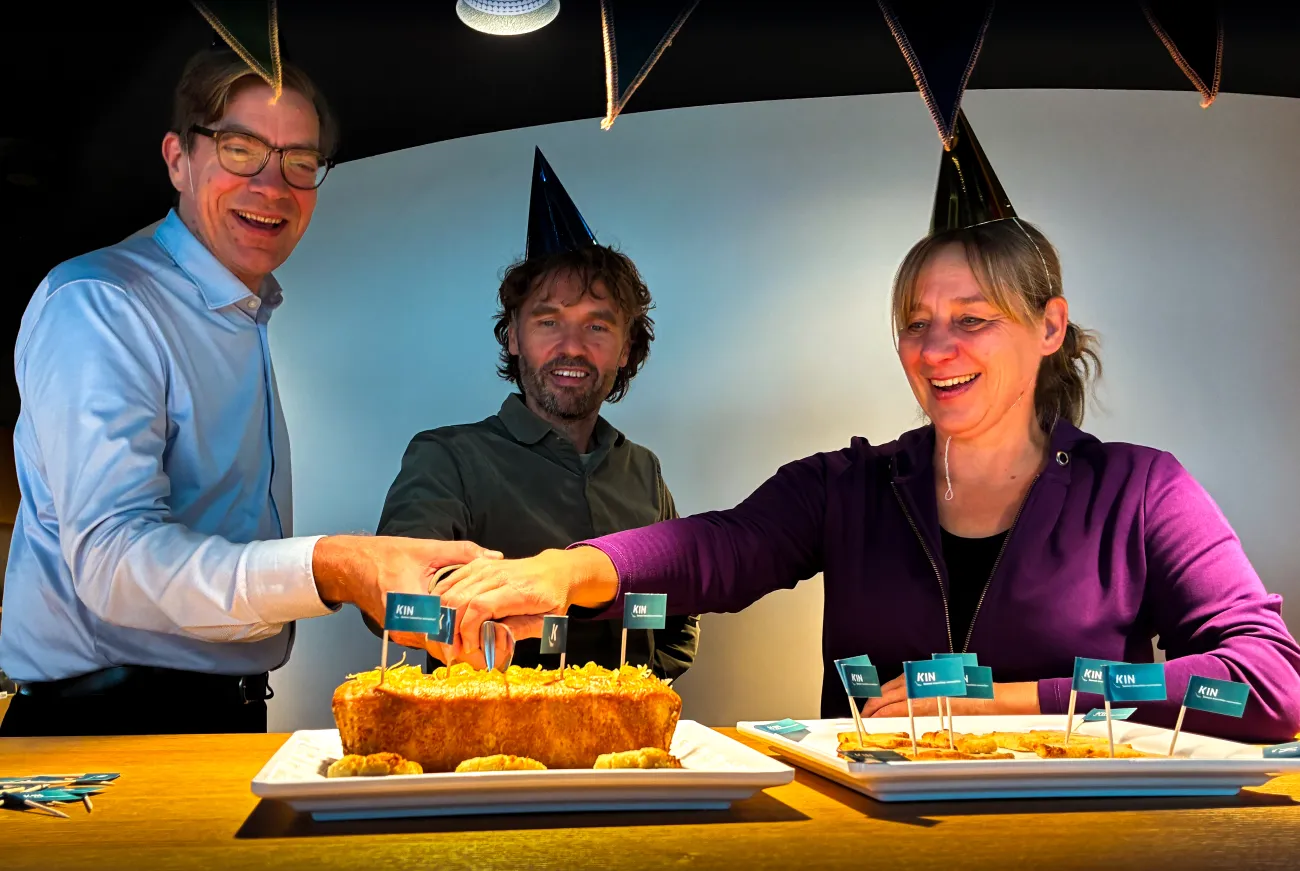
Last Sunday, November 1, 2026, the Netherlands Climate Research Initiative (KIN) celebrated its third anniversary! Michiel van den Hout (Executive Director), Derk Loorbach (Academic Lead) and Caroline Katsman (Academic Lead, Climate Science) look back on three years of KIN and look ahead.
Transition Mindset
“At KIN, there was enthusiasm and a sense of urgency from day one,” says Derk. “But we didn’t yet know exactly what the commitment to the climate transition meant in practical terms within the context of NWO. Our transition mindset has grown tremendously over the past three years.”
Michiel agrees: “We now think much more in terms of real-world practice. Who is already working on the necessary changes, what challenges are they facing and how can science support them? Based on these questions, we’ve started developing innovative funding instruments.” According to Caroline, the strength of the KIN lies in reflecting on this pioneering work: “We approach this professionally and aren’t hesitant—we’re above all curious about the outcomes and continue to assess what went well and what could be improved next time.”
“My hopes and expectations have been more than fulfilled,” Derk continues. “That we’re driving breakthroughs from within that serve as a lever for transformative science.”
“I hoped we would become a relevant player in the knowledge landscape by enabling science and society to collaborate in an innovative way on the climate transition. That we could achieve results faster by avoiding lengthy procedures in which societal partners drop out and cannot participate as equals. That we could truly harness science to support the transitions that are desperately needed,” says Michiel. “We’ve largely succeeded in that: with the help of a large group of leading scientists, we’ve built a solid reputation in a short period of time. We’ve also accomplished a great deal, and some impressive results have already been achieved. I’m incredibly proud of how much we’ve done and the results we’ve already achieved. At the same time, it remains a challenge that we’re still operating on a relatively small scale. Ideally, we’d like to mobilize many more people and resources.”
“Our ambitions are enormous, and so is our impatience with the small scale at which we’re operating,” Caroline adds. “But with this small team and budget, we’ve already planted quite a few seeds.”
What stands out to you after three years at KIN?
What has stood out most to Derk during his three years at KIN is, on the one hand, the KIN spirit during team outings—the enthusiasm and passion. On the other hand, it’s the moment during a session when he tried to explain what he meant by a transition mindset and transition behavior. “But that’s simple, isn’t it?” I sighed,” Derk recounts. “The response I got was: "No, that’s not simple at all.” That’s when it became clear that we need to explicitly define the steps and logic involved in working on transitions. That ultimately led to the Knowledge-in-Action approach and transition analysis as a method.”
Michiel adds: “For me, there isn’t a specific moment, but I’ve come to realize more and more how deeply and intimately the real causes of climate change are intertwined with our society, colonialism, capitalism and even the practice of science itself—which, unfortunately, has also contributed to the systems and ways of thinking that are now holding us back so much. At the same time, it gives me immense satisfaction that so many people—despite all the opposition and pessimistic reports—are working with conviction to find ways to do things differently and better.”
Caroline says she has learned an incredible amount from the KIN team about how to get people from very different backgrounds to work together toward the same concrete goal. “As a hardcore science person, I really had to get used to the theater exercises and questions like "What color do you associate with collaboration?", but I’ve seen how effective it can be.”
Better Collaboration, Programming and Funding
From the start, KIN was given the explicit mandate to find new ways to collaborate, plan and fund climate research. What challenges and opportunities does this entail?
Michiel: “What I like best is that NWO has given us the mandate to be a place where we’re allowed to experiment—and where it’s okay for things to go wrong every now and then. I think that shows courage on the part of our leaders. And we regularly take risks to achieve something new. Take the KIN hubs, for example, where we’re working with a group of climate centers across the country to explore how we can even better facilitate and develop transition-oriented climate research.”
“We’re tackling a major challenge in a very practical way and with tremendous enthusiasm,” says Derk. “It remains a challenge to make this clearly visible. From the outside, our approach may seem similar to the existing one, but fundamentally, we’re doing things differently: mission- and transition-oriented.”
“We provide direction,” Michiel continues, “but we don’t always know exactly how to do it either: we’ll have to discover together how to make it work. Striving for something that doesn’t exist yet—and about which everyone currently has different opinions—also makes us vulnerable. Fortunately, we see that this attitude is generally very much appreciated. I hope that this appreciation from people will remain even if something goes completely wrong. Because that’s bound to happen at some point. And if not? Then I think we’re being too cautious.”
“I think it’s an incredible compliment that people from outside the organization tell Marcel Levi that KIN is doing such interesting work,” says Caroline. “I get the impression that we’re doing things that more people within NWO would also like to see. I hope that NWO is indeed moving in that direction.”

The strength of the KIN team: ‘commons’
The KIN team is passionate, energetic, and, according to Derk, functions as a true 'commons'. “The team creates collective value by supporting one another and contributing individually to the collective.”
“The people on our team were truly recruited for their entrepreneurial spirit,” Michiel continues. “Because of our ambitious mission and the opportunities it brings, many feel that we’re really making a difference. I’m very proud of this great mix of people, nearly half of whom are on part-time secondment yet are still fully part of the team.” Caroline: “The team is truly a team and shows incredible courage.”
KIN in 10 years
When KIN celebrates its 10th anniversary, what dream will we all have made a reality?
“By then, we’ll still be in full swing—and on a much larger scale,” Derk replies. “A sustainable and just future will take a little longer to achieve, but in ten years, it will be visible on that scale. By then, the academic community will be fully engaged in researching, valorizing, disseminating, legitimizing and institutionalizing a new economy and government. And at the same time, it will play an explicit role in phasing out and eliminating the fossil-fuel-based and undesirable economy.”
Michiel: “By then, we’ll see people in a number of places who have truly started thinking and acting differently, and at the regional level, we’ll see the first climate-resilient measures being implemented.”
“I hope that by then we’ll have contributed to crossing a social tipping point: how we need to live more consciously in order to rapidly curb climate change,” says Caroline.
Three years of KIN in a single book, movie, or song title
Finally: if you had to sum up the past three years in a single movie title, book title, or song title, what would it be and why?
Derk: “Right now, I’m thinking of Naomi Klein’s 'End-Time Fascism', or the recent documentaries 'How to Live on Earth' or 'Derek vs Derek'. Or IJSLAND’s latest album—but I’ll go with Sef’s album, which still gives me goosebumps and really moved me, even live—and the song ‘Oops (too late. The future is off)' makes the most sense here.“
”For me, it’s the book 'The Ministry for the Future',“ says Michiel. ”The first fictional examples from it have already become reality. I hope that with KIN, we can help bring the wonderful solutions for the future—described at the end of the book—closer to reality."
For Caroline, three years of KIN can be summed up in 'Daring Greatly' by Brené Brown—a title inspired by a speech by Theodore Roosevelt (1910)—whose key message is:
“True honor is not due to the critic on the sidelines, but to the one who dares to struggle and fail with blood, sweat and tears in the arena of life.”