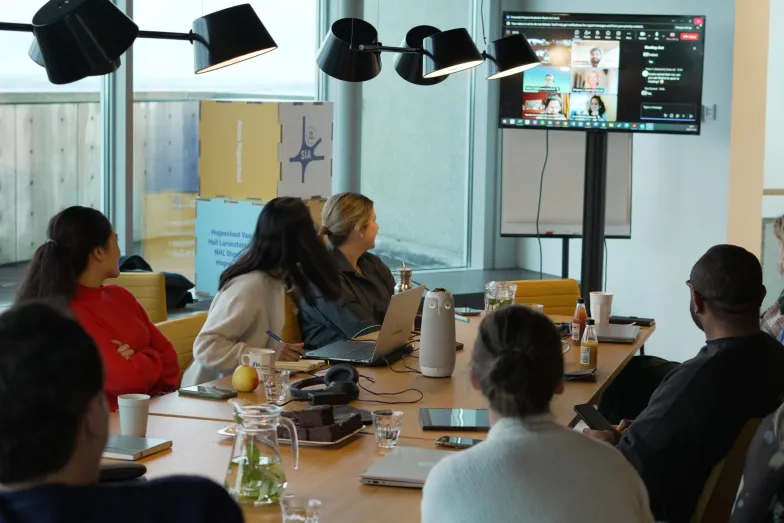
In 2024, KIN entered into a partnership with the THRIVE Institute, which specialises in creating impact and navigating complexity. The aim was to utilise their tried-and-tested method, the Purpose Accelerator, to identify pilot projects and best practices relating to (system-wide) climate transitions towards climate neutrality, and, of course, to learn from them. The aim was to gain an understanding of what is already working well and what is less effective. Which factors act as barriers and which act as catalysts? KIN can use these examples as inspiration for other researchers and to provide valuable insights for the approach that KIN itself is developing. In addition, it can highlight relevant questions for follow-up programmes.
Knowledge brokers: ‘doing by learning and learning by doing’
During the programme, PhD students apply their academic knowledge and skills, whilst also developing new knowledge and skills to work as ‘knowledge brokers’. In this new role, they can provide organisations with groundbreaking insights, evidence-based solutions and best practices from both academia and practice, thereby increasing the effectiveness of impact policy.
During the programme, the researchers spent four hours a week on training to become ‘knowledge brokers’ and putting this knowledge into practice. Meanwhile, they learn from experts in the fields of knowledge brokering, system and climate transition, and valorisation. Valorisation is the responsibility of ensuring that new scientific insights are put to use for the benefit of society. In this way, the researchers were given the opportunity to gain experience in tackling urgent and complex real-world societal issues, to establish a solid evidence base and to take concrete steps that will be useful for the KIN’s future efforts.
Over a period of five months, alongside their (various) research projects, the PhD candidates investigated best practices in pilot schemes and interventions in the field of climate neutrality and resilience. The aim was to learn how best to harness the potential of societal frontrunners and the scientific community for the climate transition, whilst also gaining insight into best practices and barriers within the existing system. What do we need to organise (better) to deploy relevant insights from research, policy and practice as quickly and effectively as possible to achieve societal impact?
The outcomes of the THRIVE Purpose Accelerator
For the individual researchers, THRIVE marks the start of their careers as knowledge brokers. They laid the foundations for a new role in which subject matter experts have one foot in academia and one foot outside it. The first cohort of participants produced a practical framework for selecting pilot projects and interventions, as well as concrete strategic recommendations for the KIN to enhance its impact. The framework can also support any subsequent group who, like them, will be working as ‘knowledge brokers’ in selecting those projects that can truly act as a driving force for systemic change in the Netherlands. As their careers progress, the PhD graduates will strive to utilise as many relevant insights from academia as possible to find answers to complex societal questions.