The coalition agreement will not accelerate system changes.
The reactions to the coalition agreement are coming in thick and fast; joy, sadness, hope, disappointment, pride, anger… everything is passing by. As KIN, we are relieved to hear that climate policy is not completely being thrown out, as initially proposed by PVV leader Geert Wilders in his election program. However, we also see that the proposed measures do not bring system change any closer.
A comprehensive vision is lacking
The word “system change” (or “system transition”) does not appear in the agreement. The main agreement is clearly aimed at maintaining the existing system, while we know that our system, based on the depletion of resources, nature, and biodiversity, is unsustainable and is already reaching its limits in many areas. To work towards a sustainable society, an integrated approach is essential. Otherwise, the temporary solution of one problem will continually lead to the emergence of other (new) problems.
The contradictions within the proposed measures, as well as the lack of coherence between climate, healthcare, land use, energy, agriculture, and the economy, illustrate the shortcomings of the main agreement. Climate goals will not be achieved by encouraging gas extraction in the North Sea, subsidizing diesel, or increasing speed limits to 130 km/h. The proposed “solution” for the manure problem—seeking exceptions to (Brussels) regulations—does not address our poor soil and water quality or the further decline of our biodiversity. Reducing internationalization and cutting funds for science, education, EU contributions, and development aid are not the answers to cross-border challenges. Issues concerning security, climate change, and pandemics require new and integrated knowledge. Without a systemic vision, we are merely mopping with the tap open and passing our problems onto future generations.
KIN continues to work towards systemic change
Systemic solutions are needed. And the good news is that these solutions are available. It is possible to save costs preventively by investing in nature and water quality. The Dutch food chain can offer solutions for biodiversity, water quality (clean drinking water), and climate adaptation. Moreover, the energy transition and biodiversity can complement each other very well.
KIN will continue to focus on climate, science, collaboration, and system transition in the coming years. This main agreement primarily highlights that KIN and what we stand for are more necessary than ever for gathering and integrating knowledge to support a comprehensive and fair transition to a more sustainable world. We will continue to work tirelessly towards this goal without borders!
Is there anything you can do?
More than ever, we must strive to make climate-related knowledge from science usable and effective in our society. This can be achieved professionally and scientifically by joining the working groups, networks, and programs of KIN. On a personal level, there are also plenty of ways to contribute, such as reducing your carbon footprint.
Further reading, in addition to the links already mentioned in the text:
- Publication of the 2023 cabinet formation with download link to the coalition agreement (Dutch)
- NWO article on the knowledge coalition’s response
- Reaction of Nature & Environment (Dutch)
- Reaction of ING economists to the agreement (Dutch)
- Article by The Correspondent on agriculture, arguing Why the agreement only supports big agro industry (Dutch)
- Article by The Correspondent explaining how this main agreement fails to solve the housing crisis (Dutch)
Related news
Three years of KIN. Three leaders. One mission: to drive and embed the climate transition.
Last Sunday, November 1, 2026, the Netherlands Climate Research Initiative (KIN)...
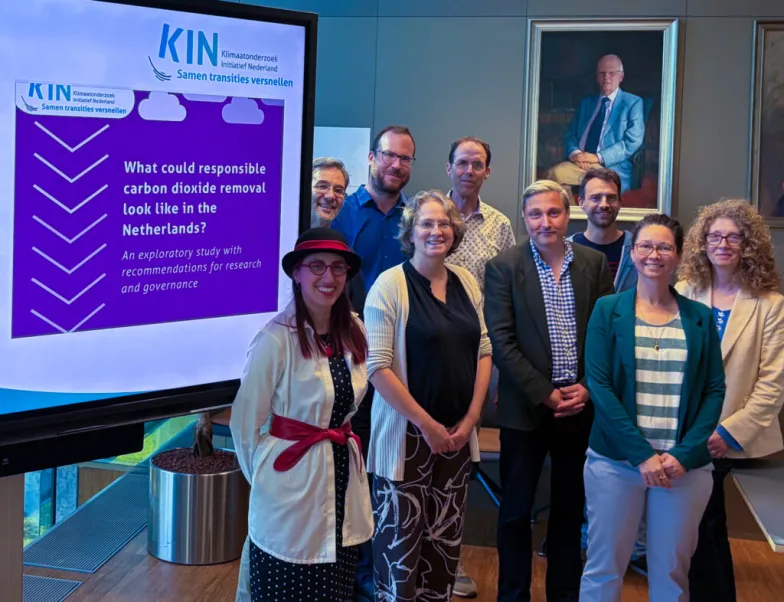
Report examines the environmental and social aspects of large-scale carbon dioxide removal
There is a strong national and international focus on large-scale carbon dioxide...
New report guides science sector in becoming more sustainable
From research institutes, colleges and universities to university medical...
Climate knowledge seeks policy maker
How can we make scientific knowledge more accessible to policymakers?
This...
Pick up the phone and call our Hotline for Intangible Impact
When KIN funds projects, supports workshops, events or KIN Pact activities, it...

New opportunity for Caribbean climate transition networks
Express your interest in the KIN Network Funding Caribbean!
Are you working...
Call for stakeholders to contribute to a Dutch version of the IPCC Special Report on Climate Change and Cities
On 29 May 2026, the KIN organised a second expert consultation at the KNMI in De...
Documentary ‘Re-rooting: Indigenous perspectives on just transitions’ is now available online!
‘Re-rooting: Indigenous perspectives on just transitions’ is now available...
“We need to go to relationship therapy with water”
Over the centuries, our relationship with water has gone completely off the...
How can our economy contribute to well-being and a liveable planet? 25 projects are shaping the economic transition with the ‘Knowledge-in-Action’ grant
What does an economy look like that is not purely focused on growth, but also...
‘Impossible Projects’ workshop: researchers and funders taking on each other’s roles
On May 18, during the SIA conference ‘Research and Creative Practice’ at the...