



The Sensory Journey is designed by KIN Artist-in-Residence Sissel Marie Tonn, with the support of the KIN teamand as part of the third Crutzenworkshop on economic transition: “The Costs and Benefits of (In)Action”. The workshop consisted of a twoday design session and took place in Rotterdam on January 28 and 29.
The aim was to create a ‘Portal’ for the Crutzenworkshop that could function as a transition ritual, giving participants the opportunity of exploring how we might step away from a traditional, linear economy and move toward a circular, regenerative one.
When we think of ‘the economy’, we often imagine something cerebral, abstract, perhaps even virtual: flows of currency, market fluctuations, spreadsheets. Yet our eyes, skin, tongue, ears and nostrils are the gates through which our bodies make sense of the world, and they are influenced by our experiences, cultures, memories and lived reality.
From this place, we created a ‘sensory journey’ across the two-day workshop, intended to evoke different forms of sensory engagement. These took the shape of subtle rituals — moments to share together, or return to individually when a small reprise from the more cerebral elements was needed. We spoke about rituals as reminders of values, but also as practices we can repeat: embodied gestures that gradually settle into the body and mind.
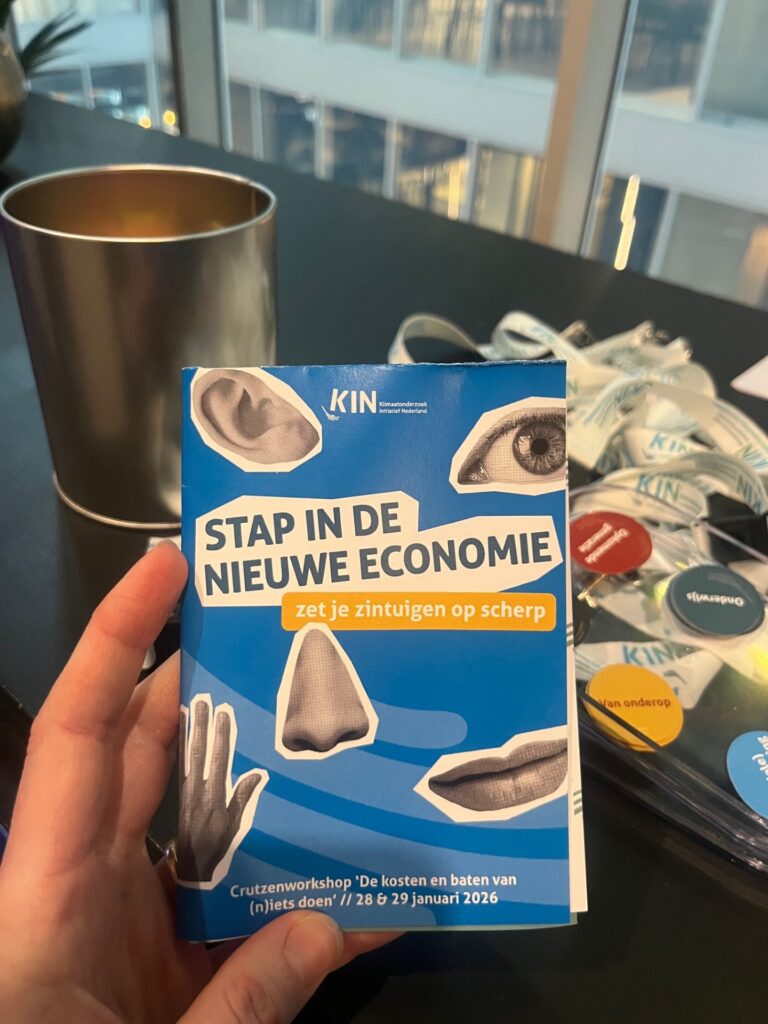
We designed a small ‘zine’, functioning both as instructions for five sensory tasks and as a stamp card that — when full — granted access to a small goodie bag at the end of the workshop. This was a tongue-in-cheek nod to value creation and the transactional logic of the ‘old economy’, while proposing a different form of currency: attention.
Taste
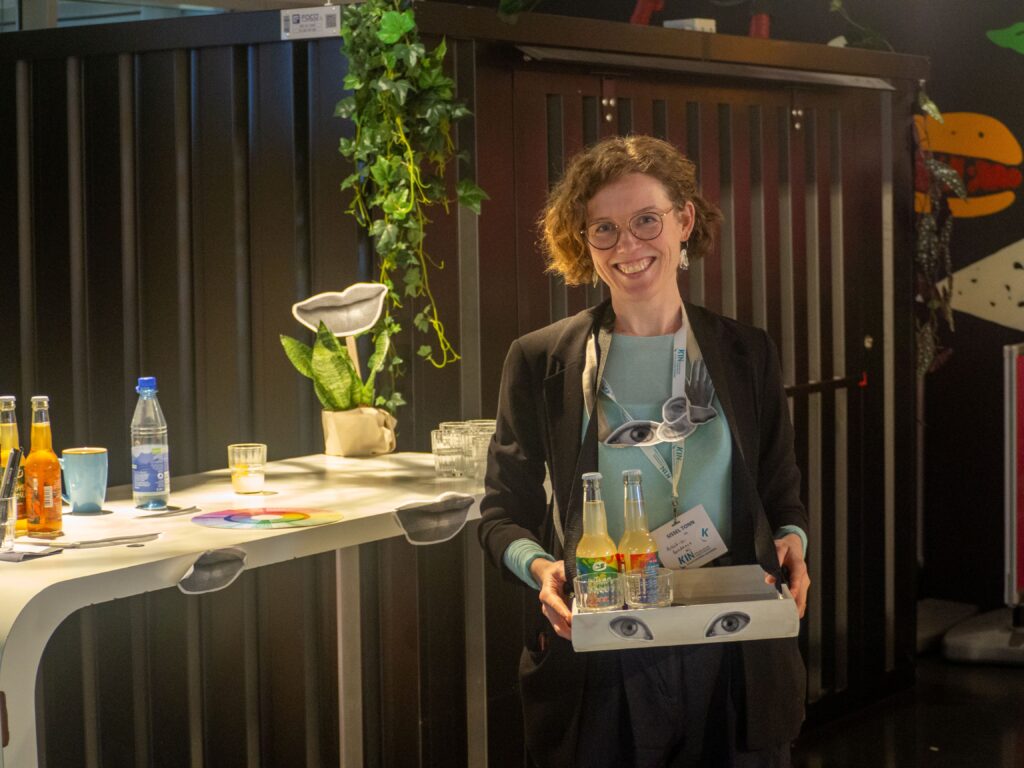
The first sensing challenge focused on taste. We opened the workshop with a toast in kombucha , a fermented tea created through the symbiotic relationship between bacteria and yeast. Participants were invited to describe its flavor in words. Easier said than done! It was fascinating to see who ventured beyond the first impressions, searching for more subtle, hard-to-name notes, with closed eyes and full attention.
Toasting in kombucha reminded us that we are always more than ‘one’. Even though we think of our bodies as “ours,” at least half of the cells that make us are non-human. With its probiotic microbes, kombucha points to how care for ecosystems happens not only around us, but also within us. Did you know your unique microbiota affects how you perceive flavor? We are all holobionts, arriving with different experiences and memories, shaping how we meet the day.
Seeing
Have you ever gone mushroom hunting, or searched for a four-leaf clover? Often, the trick is not to look too hard. You soften your gaze… and suddenly, something appears.
The second challenge explored seeing, or what anthropologist Anna Tsing calls The Art of Noticing. Participants were invited to attend to their surroundings differently. The workshop itself was about finding new perspectives, angles and collaborations. How might looking differently help you notice subtleties in your own work or partnerships that might otherwise fall under the radar?
By pasting small eyes throughout the Nhow hotel in central Rotterdam, we invited participants to notice what usually goes unnoticed.
Listening
The third challenge asked participants to gently disrupt their habits of perception through the practice of Deep Listening. Working toward change means working with people — each with their own perspectives, habits and convictions (including ourselves). Deep Listening invites us to fully attend to another person before forming our own response.
Listening deeply is a gift, and also a challenge. It creates space for shared understanding and unexpected common ground. Moderator Marsha Simons introduced this practice as a primer on the first day, giving everyone a chance to try it. The real challenge, of course, is remembering it in every interaction.
Touch
The fourth challenge related to our largest organ: the skin. On the morning of the second day, we offered a moment to ‘wash off’ lingering tensions or stuck energy from the day before. Lisa led a beautiful session reconnecting us with breath and bodily awareness, eventually activating our nervous systems through a guided body ‘wash’.
Smell
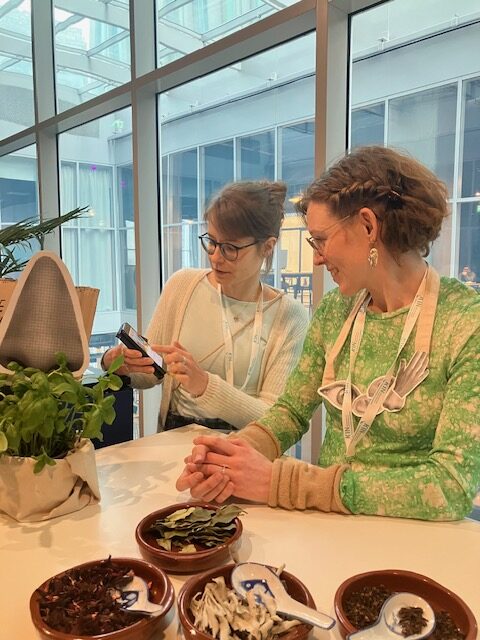
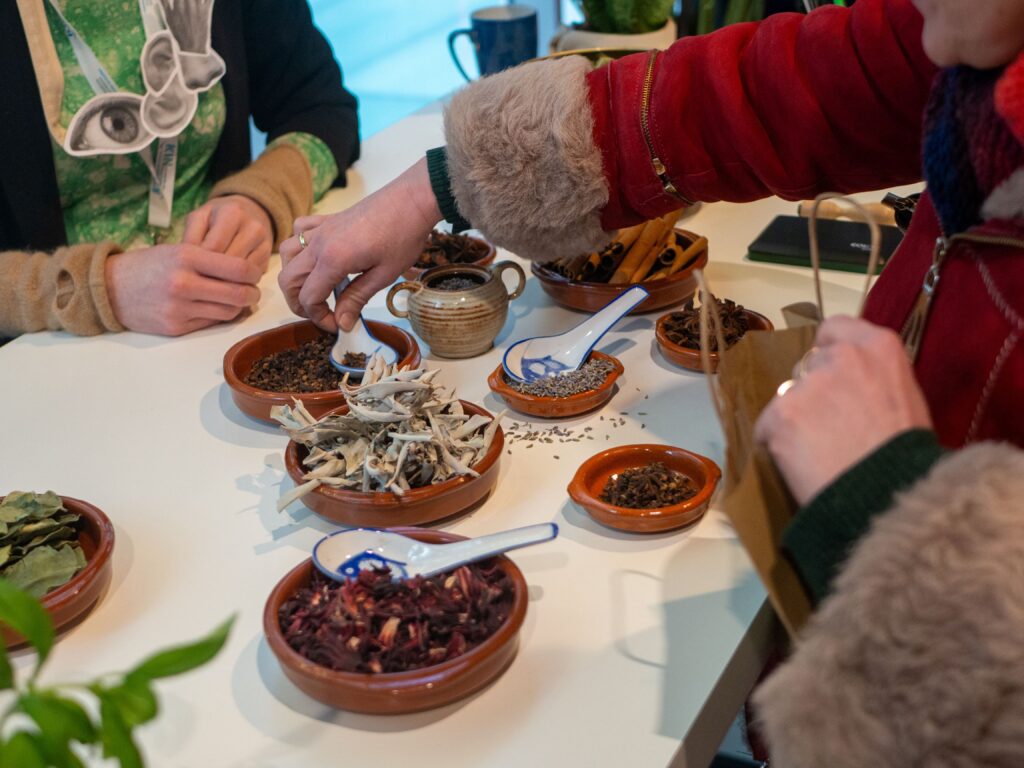
The fifth and final ‘exit ritual’ invited participants to connect with our oldest sense: smell. Closely intertwined with memory and emotion, scent has the ability to anchor experiences in the body, allowing moments to linger beyond language. We invited participants to create a ‘transition perfume’ by blending herbs and spices, while intentionally connecting a specific memory, encounter, or feeling from the workshop to that scent – something to carry with them as they stepped back into their everyday rhythms. Again, this naturally brought up stories from particpants of their existing memories and associations with the herbs and spices we had chosen, as well as possible new configurations, where these plant-kin could be implemented into transition work.
What’s next?
It was both interesting and challenging to develop a program within the program — one that gently redirected attention toward the wisdom and intelligence of the body, beyond the cerebral. While some participants skipped the exercises altogether, others asked for them to become even more central to future workshops, contemplating how conversations mightbeen different if the smelling of lavendar was performed before each of us would speak. This tension felt like an important lesson: embodied practices ask for time, vulnerability, and a slowing down that doesn’t always sit easily within professional settings.
A regenerative economy places the well-being of the Earth and all its living beings before growth and profit. As we make both big and small shifts in this direction, it becomes important to recognize value systems beyond the monetary. When we pay attention to the ways we are in relation — how our bodies are rooted in a wider ecological web — we become more inclined to fight for non-destructive system change, where the reward isn’t financial.