

On Wednesday, April 15, the 4th KIN ACT Consortium Day took place at Het Gemaal op Zuid in Rotterdam. A location in the heart of the Afrikaanderwijk, known for its local ownership and neighborhood-driven initiatives. Focus this day was on accelerating a just climate transition in the neighborhood. With special attention to heat stress, climate justice and the valuation of knowledge from the neighborhood.
The day offered a variety of inspiring interviews, presentations and discussions, together with a tour through the neighborhood. From different perspectives, it became clear how strongly climate issues are intertwined with social justice, housing and health.
Justice at the center and highlighting heat-related injustice
Central theme of the day was: how can we work towards just answers in response to climate issues in the neighborhood, with heat stress as a concrete example?
During the morning, three speakers were interviewed. Each of them with a different perspective on heat stress and climate justice.
Esther Wienese (Rotterdam Heat Plan / GGD Rotterdam-Rijnmond) addressed the health risks of heat, with special attention to the elderly and vulnerable groups. She explained the Rotterdam Heat Plan and initiatives such as the HitteLab . And emphasized the importance of self-reliance in the neighborhood. At the same time, it became clear that behavioral advice – such as drinking enough fluids, seeking shade and adjusting daily routines – cannot be self-evident and even culturally determined. The presence of key figures in the neighborhood is crucial: people ‘with their feet on the ground.’ Who can also fulfill their role structurally as well as paid. The upcoming Heat Action Day on the 2nd of June and the acquiring of multicultural knowledge regarding dealing with heat, were both mentioned as important opportunities.
Paula Zwitser (Afrikaanderwijk Cooperative / Rotterdam Weerwoord) discussed the role of the Afrikaandewijk Cooperative and the Rotterdam Weerwoord program. She outlined the way climate adaptation is taking shape in twelve neighborhoods in Rotterdam. And the reason why traditional participation is falling short. She highlighted that just climate transition requires collaboration with residents from the very beginning. All with equal appreciation for knowledge from the neighborhood. Residents and key figures must not only be involved but also be paid for their expertise. Climate justice is a necessity: because climate change exacerbates inequality. And also an opportunity: to reduce existing inequality.
Lore Van Praag (Erasmus University Rotterdam) presented insights from research into heat stress among people with a migration background. She showed the way experiences and knowledge from countries of origin offer valuable alternative perspectives on dealing with heat. Both indoors and in daily life. Themes as flexibility, respect for natural conditions and other ways of coping with heat (e.g., nutrition) were also discussed. Lore van Praag advocated for attention to diversity in experiences. And for acknowledging inequalities, where justice is not easy to define but must be made visible.
After the interviews, researchers from the KIN-ACT program reflected on the shared insights.
Exploring and listening
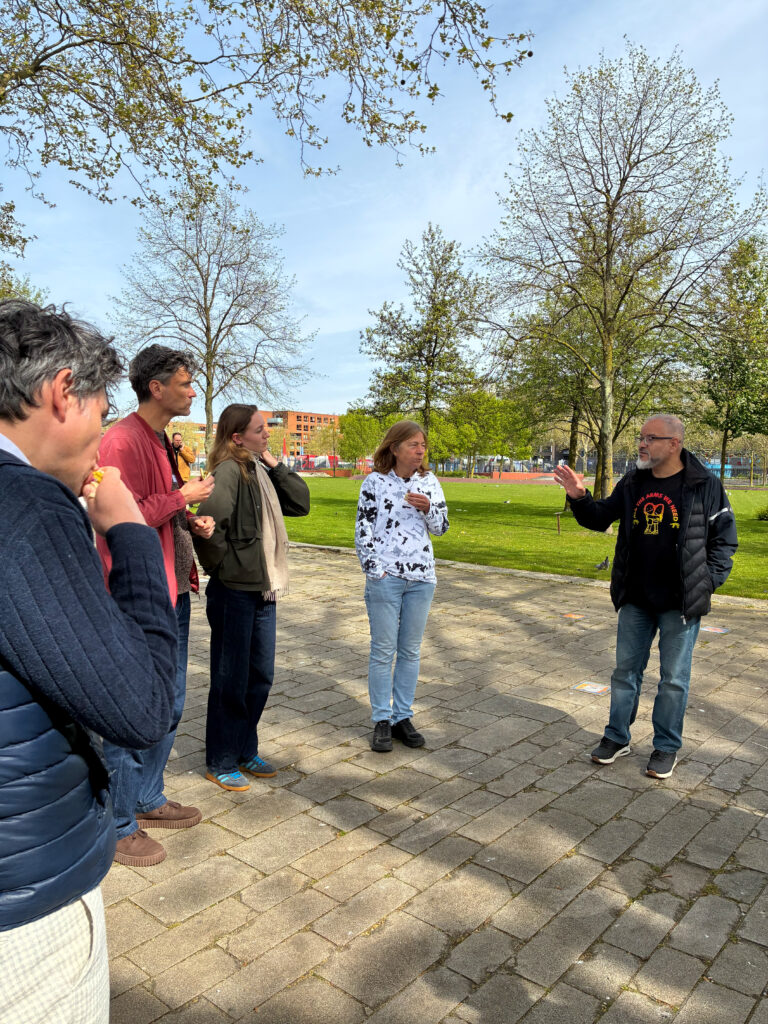
During lunch, participants explored the neighborhood around Het Gemaal op Zuid. Here they were introduced to climate and neighborhood initiatives. Along the way the Municipality of Rotterdam’s demolition and renewal policy was discussed. Personal stories from residents highlighted the socio-cultural value of homes and neighborhoods, as well as the profound impact changes can have. This segment provided a tangible context for the conversations regarding justice, housing and climate.
Fusions of interests as the key to transition
In her keynote, Anke van Hal spoke about the importance of creating fusions of interests regarding the energy transition in vulnerable neighborhoods. She emphasized that real progress requires collaboration between social and technical domains. And that transitions rarely proceed linearly. She also noted that slowing down is sometimes necessary to eventually accelerate, especially in collaboration with residents. Using concepts such as antifragility and goal framing, demonstrated how social, ecological and economic interests can be interconnected. This way, the energy transition can function as a catalyst for broader neighborhood improvement.
Deepening through dialogue
In the World Café, participants from the various ACT work packages engaged in interactive table discussions on current issues surrounding climate transition and justice. The conversations built upon the themes of the day: justice, resident involvement, institutional barriers and opportunities for collaboration, how shared challenges play out differently locally and which lessons can be exchanged between cities and districts.
A joint restrospective closed the day. The Consortium Day underlined the importance of the structural involvement of residents, an equally valuation of knowledge from the neighborhood and a continued attention regarding the background, position and knowledge of residents.