Towards Courageous Conversations
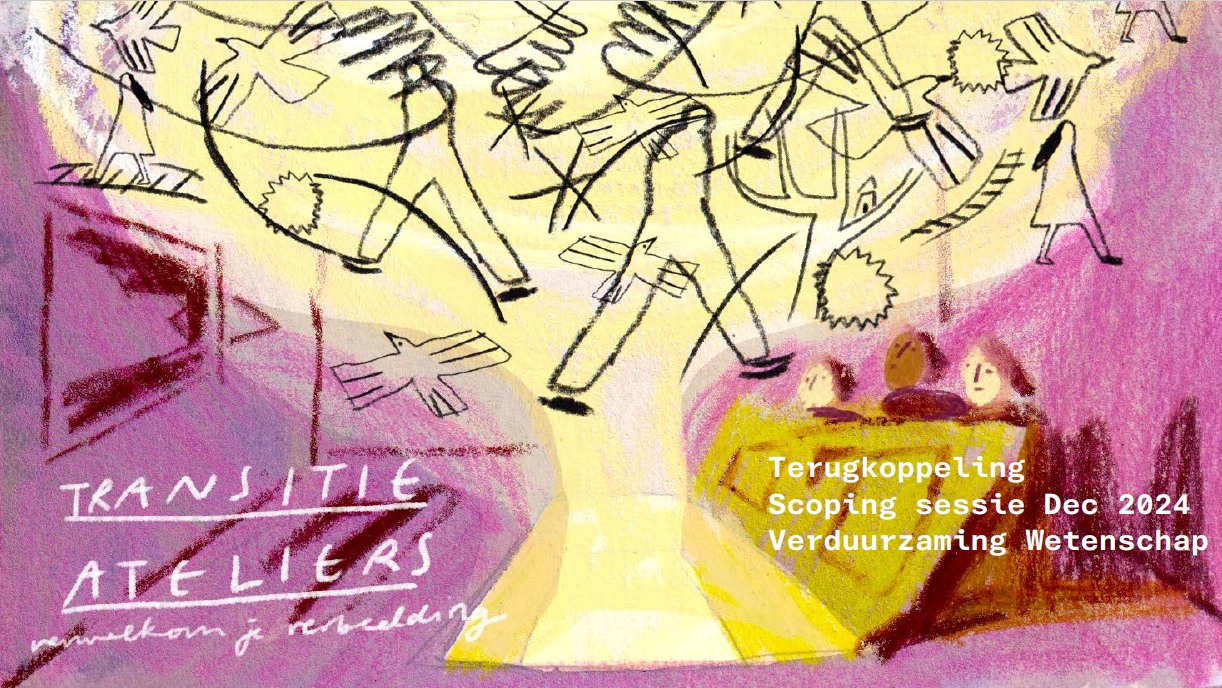
Read the report of the first scoping session for ‘De Tafel van Moedt’ via the button below.



project
Science plays a role model in society, including in sustainability. ‘The Tafel van Moedt’ (“The Table of Courage”) is a new tool designed to accelerate the sustainability of science. The ‘Tafel’ does this by fostering the courage and gentleness needed to develop a future-proof research and science system.
Duration
november 2024
–
Heden
Budget
€ 50,000
Parties involved
OCW, NWO, GreenLabsNL, DRIFT (Ties van Daal and Almar Bok), Arlon Luijten
Theme
‘De Tafel van Moedt’ is the result of a December 2024 meeting with representatives from various umbrella organizations in the research and science domain, as well as bottom-up initiatives like GreenLabs NL, Green Young Academy, and Students for Tomorrow. The starting point was the idea of using designers and transition workshops to facilitate action-oriented conversations that accelerate the transition to sustainable science and bring together various initiatives. Invited by the Ministry of Education, Culture and Science (OCW), NWO, DRIFT, and KIN, they worked together during a transition workshop on the sustainability of science in a scoping session.
They did this in collaboration with theater director Arlon Luijten, Ties van Daal, and Almar Bok from DRIFT. ‘De Tafel van Moedt’ are the result of these sessions. They are ‘urgency creators’ that can inspire leaders of major organizations in science to take action.
‘De Tafel van Moedt’ create a space for encountering that which we often avoid in our search for our role in societal transitions. They open up a space for exploring how best to deal with what we encounter in this confrontation, as we develop new ways of understanding and acting.
‘De Tafel van Moedt’ is an interactive physical object and methodology that can help a learning community to choose collaboration over competition, to harness collective knowledge and to make space for vulnerability and innovation. The methodology invites participants to make courageous choices. Getting started with it takes courage, but the tables also give courage. It is about dreaming together, doubting and ultimately taking concrete steps.
They are an invitation to seek out ‘the conversation that hasn’t been had’. You take part in a session in which you engage in conversation with others about an issue that is urgent and requires action.
We often find that we go round in circles. That we are keen to pass the hot potato on quickly. Or that we do not fully feel or understand our responsibility and therefore fail to take decisive action or arrive at new insights. At ‘De Tafel van Moedt’, that is not possible. The conversation is designed in such a way that you cannot leave the table until clear statements have been made and bold actions have been promised.
We do this not only through transition-focused problem statements, probing questions and perspective-broadening activities. Through storytelling and art, we build an immersive world around the conversation, which encourages people to approach the issue differently.
We do this through a retelling of the myth of Theseus. Theseus was tasked with defeating the Minotaur, the monster trapped in a labyrinth. Monsters are those phenomena that do not fit within existing categories. ‘The old world is dying, and the new is struggling to be born: this is the time of monsters,’ this famous statement by Antonio Gramsci remains relevant today.
Thus, Gramsci’s monsters, existing between chaos and emergence, harbour elements of the old and the new, which stem from different, and perhaps even irreconcilable, logics. Monsters are therefore not unambiguous phenomena. So when we view monsters not as something to be avoided, but as something that offers insight into stagnant systems and frameworks of thought, the monstrous becomes precisely something we must seek out, something we must encounter.
The myth of Theseus and the Minotaur also teaches us that there are different ways of dealing with the monster. Daedalus, the architect of the labyrinth, not only created a complex system to keep the monster contained, but also, at an earlier stage, built the structure in which the Minotaur was conceived. King Minos is ashamed of the Minotaur and hides it away. Ariadne demonstrates how an encounter with the monstrous is possible without getting lost in the labyrinth. Theseus sees the monster primarily as something that must be defeated. Pasiphaë, the monster’s mother, shows that the monster is related to us. The monster is therefore not unambiguous, nor is the correct way of dealing with it.
‘De Tafel van Moedt’ is a transdisciplinary creative research project situated at the intersection of transition science, art, philosophy and learning design. This hybrid collaboration between artistic imagination and systemic, transition-oriented thinking has yielded this working method. Because Tafels van Moedt emerged from a transdisciplinary collaboration, it is itself also a hybrid form, between art and science. Have we ourselves given birth to a monster? Have we, with this monstrous machine, encouraged others to give birth to monsters?
It looks like a machine, but it is a workshop.
It looks like a workshop, but it is an experience.
It looks like an experience, but it is a decision-making tool.
It looks like a decision-making tool, but it is a work of art.
It looks like a work of art, but it is a co-creation session.
It looks like a co-creation session, but it is a dream.
It looks like a dream, but the impact is real.
This autumn, the developers involved will be testing ‘The Table’ in six major sessions. The end product of ‘The Table of Courage’ is expected to be available from October 2026 (targeted launch during Dutch Design Week 2026), so that the first courageous conversations can begin this autumn.
The idea for ‘De Tafel van Moedt’ originally arose within the KIN’s ‘Science in Transition’ programme line and has since developed into a widely applicable methodology. Within the ‘Science in Transition’ programme line, the KIN explores new ways of collaboration and funding, as well as facilitating working methods and processes that can support and accelerate just and sustainable climate transitions.
Read the report of the first scoping session for ‘De Tafel van Moedt’ via the button below.
Please contact us.