


There is a strong national and international focus on large-scale carbon dioxide removal (CDR) from the atmosphere in order to meet climate goals. But how can this be done responsibly? A study commissioned by the Dutch Climate Research Initiative (KIN) highlights the ecological and societal impacts and preconditions that must be taken into account.
Growing interest in CDR
The report ‘What could responsible carbon dioxide removal look like in the Netherlands? An exploratory study with recommendations for research and governance’ is the result of a study conducted by the University of Twente, Delft University of Technology and Deltares. It explores the possibilities for large-scale upscaling of carbon dioxide removal in the Netherlands. CDR has moved higher on the political agenda, including in the Dutch government’s most recent National Climate Plan. Organizations such as the Intergovernmental Panel on Climate Change (IPCC) and the Scientific Climate Council (WKR) state that large-scale carbon dioxide removal will likely be necessary to achieve the climate goals of the Paris Agreement. This primarily involves removing CO₂ emissions that cannot be prevented through emission reductions at the source (the so-called ‘overshoot’).
Many questions remain about the large-scale implementation of CDR
Researchers still have many questions about the large-scale application of CDR technologies, particularly regarding their potential negative ecological and societal impacts. They see a significant risk in focusing on the widespread use of carbon dioxide removal, which could inadvertently come at the expense of efforts to reduce CO2 emissions themselves (also referred to as ‘mitigation deterrence’). Another aspect that the researchers believe needs to be examined is the significant strain that CDR can place on land, water, raw materials and the energy supply in a small and densely populated country like the Netherlands. This, in turn, could lead to the (potentially unjust) shifting of burdens to other regions of the world, for example, in the extraction of necessary raw materials. The researchers conclude that none of the available CDR technologies is currently ready to achieve the desired scale of upscaling in the Netherlands.
To achieve responsible CDR scaling up, the researchers argue, a well-thought-out policy framework is needed in advance— one that addresses these aspects not only from a technological perspective but also from social, ecological and systemic perspectives. This can help prevent the cure from being worse than the disease.
Exploration from multiple perspectives
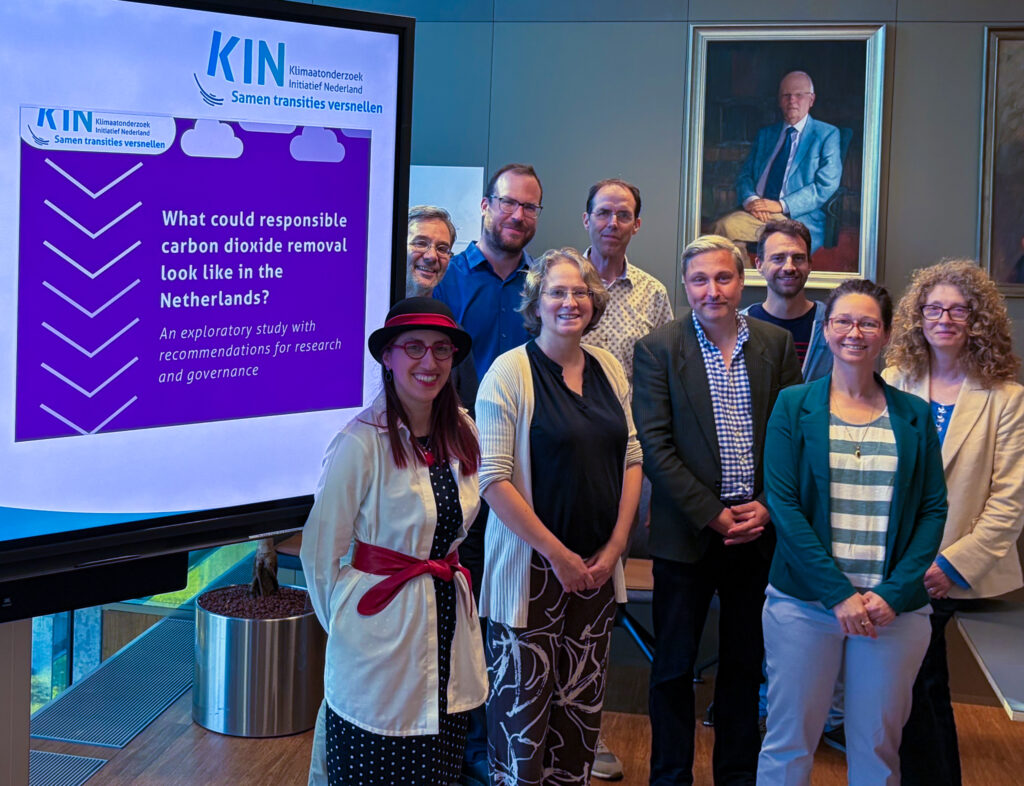
To provide a broad perspective on CDR, thirteen researchers from a variety of disciplines—including engineering, geography and the social sciences—collaborated on this project. This interdisciplinary approach ensures that the opportunities, limitations and risks of CDR are assessed as objectively as possible.
The environmental and social impacts of twelve different CDR technologies have been assessed in this way. These were categorized into terrestrial biological CDR (such as afforestation and the harvesting and storage of CO₂-containing biomass), ocean-based CDR (such as the cultivation and sinking of biomass in the ocean), and geochemical CDR (such as direct CO₂ capture from the atmosphere). The study analyzes each technology in terms of its technical readiness for the necessary upscaling, resource use, integration potential and risks, and identifies areas where further research is needed.
Continuation of the knowledge program
The report makes it clear that there are still many questions to be answered before the Netherlands can achieve a responsible, equitable and environmentally friendly scaling up of CDR. In addition to six principles for a responsible CDR policy, the report offers five recommendations for further research to address identified knowledge gaps. Based on the findings of this report, KIN aims to further encourage research, practice and policy to chart the right course for responsible CDR, so that CDR can truly contribute to a sustainable society for the future. In the spring of 2027, KIN will announce further plans for a follow-up research program, possibly in collaboration with public partners.
More information
The report and the summaries in Dutch and English are available on both the University of Twente Library website and the KIN website. See the buttons below.
Contact person: Mirko Lukacs (program coordinator KIN) m.lukacs@nwo.nl